Old House Life Extension Plan 2026: up to NT$9.6M subsidy—eligibility & application steps.

Old House Life Extension Plan 2026: up to NT$9.6M subsidy—eligibility & application steps.
Over time, the biggest problems with a house aren't its appearance, but rather loose tiles, aging pipes, and increasingly difficult stairs. In recent years, many people have inquired about subsidies for repairing old houses. The central government has launched the "Old House Life Extension and Functional Restoration Plan," targeting apartments on the 4th to 6th floors and detached houses below the 6th floor that are over 30 years old. The plan aims to improve safety, accessibility, and basic living functions without necessarily requiring demolition and reconstruction. This article will guide you through applying for old house repairs, the amount of subsidies available, and where the most common obstacles lie.
Eligibility Criteria for Old House Renovation Subsidies: First, check if you are eligible.
(Image source: Ministry of the Interior's official Facebook page )
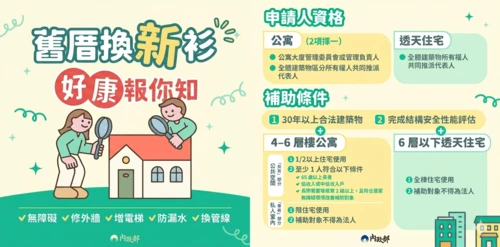
Not all old houses can be submitted directly. There are several clear criteria for old house renovation subsidies: the age of the house, the building type, the residential use, and the degree of integration among residents. Clarifying your eligibility first will prevent you from getting stuck at the first hurdle after preparing the necessary documents.
If you are eligible, you can quickly check yourself against these criteria:
• Building age requirement: The building must be a legal building that is 30 years or older.
• Building type: mainly 4- to 6-story apartment buildings, or detached houses with fewer than 6 floors.
• Conditions of use: When applying for repairs to the common areas of an apartment, the residential usage ratio must be more than half; for repairs to the private parts of an apartment or a detached house, the entire building must be used as a residential unit.
• Integration threshold: The initial seismic assessment of the apartment usually requires the consent of more than half of the owners; when formally applying for repair subsidies, in principle, the management committee or the person in charge of management shall submit the application after a resolution of the owners' meeting; if there is no management committee or person in charge of management in the community, all owners of the separate units must agree and appoint a representative to apply.
• Additional conditions: If there are elderly people aged 65 or above, low-income households or lower-middle-income households in the building, or those who meet the eligibility criteria for long-term care and home accessibility improvement, the maximum subsidy for indoor repairs can be increased from NT$200,000 to NT$300,000 per household.
• No subsidy will be granted for: buildings that are owned by a single owner, buildings that have already applied for a building permit or demolition permit or have been identified as needing to be demolished, buildings that have already entered urban renewal or dilapidated housing renovation procedures, and buildings that have already applied for other similar subsidy programs.
Old house renovation subsidy | Application process | It's better to integrate residents first before starting construction to avoid wasting time.
Many people want to get a quote from a contractor as soon as they hear about subsidies, but these kinds of cases are more like "doing your homework first, then doing the work." The order in which old house renovations will not cause any obstacles is usually not to start construction first, but to confirm consent, conduct an assessment, submit documents, get approval, and then award the contract.
The first step is to integrate the residents and conduct a seismic resistance assessment.
Before an apartment building can be renovated, the consent of more than half of the property owners must be obtained, and then an official assessment agency must be contacted to conduct a seismic resistance assessment. The initial seismic resistance assessment subsidy is capped at NT$15,000 per building, and if necessary, the detailed assessment subsidy is capped at NT$400,000 per building. This assessment is similar to giving the building a health check, letting the community know the building's condition and the direction of subsequent repairs.
The second step is to organize the renovation project and application documents.
When submitting the application, you will need documents such as proof of legal building status, a copy of the building registration from the past three months, and minutes or consent documents from the owners' meeting. Simply put, this step is not just about listing what you want to repair, but about preparing all the necessary information at once: "why you want to repair it, who agrees to the repair, and what proof you need to repair it."
The third step is to submit an application to the local government's service window.
Currently, publicly available official information indicates that the Old House Longevity Extension Special Zone provides application procedures, document downloads, and consultation windows. However, the processes of application acceptance, review, approval, subsidy disbursement, and reimbursement are all handled by the municipal or county (city) governments. In other words, the central government provides the system and the special zone, but the actual receipt and review of applications still occur at the local level.
The fourth step is to begin construction only after obtaining the approval letter.
This step is very important; please don't rush into construction. You should first submit the required documents and apply for approval, and then proceed with construction only after the local government has reviewed and approved them. In principle, construction should be completed within one year from the date of issuance of the approval letter.
The fifth step is to process the payment request and write off the work after completion.
Extending the lifespan of an old house isn't about getting cash upfront and then figuring out how to repair it; it's about completing the necessary procedures first and then applying for funding from the local government. In practice, the documents, the scope of the project, and the local review process are all crucial. Therefore, it's essential to clarify the details with the relevant local office before submitting your application; this usually saves a lot of time spent on resubmitting documents.
Old Housing Repair Subsidy | Understand the Subsidy Calculation First: 9.6 Million Yuan Doesn't Mean One Household Receives 9.6 Million Yuan
Seeing "up to 9.6 million" is tempting, but don't rush to imagine it as a free renovation of the entire house. The key point of the old house repair subsidy is that: for apartments, the focus is on improving the common spaces of the entire building, while for interior renovations, it's an additional option for each unit; therefore, the amount ranges are very different, and the subsidies are completely different as well.
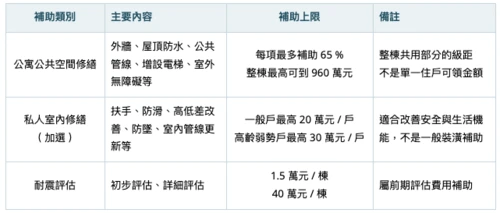
Quick understanding of subsidy tiers:
• Some individual items also have their own upper limits: for example, the maximum for adding lifting equipment is 4 million yuan per building, the maximum for building facade repair is 3 million yuan per building, the maximum for stairwell repair is 400,000 yuan per building, the maximum for public pipeline repair and renewal is 500,000 yuan per building, and the maximum for adding or improving barrier-free facilities is 400,000 yuan per building.
• 9.6 million is the highest ceiling size for the entire apartment building when multiple public space projects were carried out.
• This figure is not the amount of subsidy that a single household can directly receive.
• If you only want to improve your home's indoor security and basic functions, the actual cost will usually fall into the range of 200,000 to 300,000 per household.
• Therefore, you must first clarify before applying: whether this is to improve the common areas of the entire building or to add optional renovations to the interior of a single unit.
Old House Renovation Subsidies | Frequently Asked Questions | Explaining the Most Common Problems First
Q1. Can I apply for home renovation separately from the 2026 old house renovation subsidy?
No, it can't be treated like a regular interior decoration subsidy. For apartments, to apply for repairs to the private area, you must first apply for at least three repairs to the common areas before you can add interior repairs; for detached houses, you must first have at least one exterior repair before you can add interior repairs. If you only want to repair your home and don't want to improve the common areas, you should look into other housing subsidy programs.
Q2. If the neighbor disagrees, can I still apply for old house repair subsidies?
It depends on which stage you're stuck at. Preliminary seismic assessments usually require the consent of more than half of the property owners; formal applications for repair subsidies, in principle, must be submitted by the management committee or the person in charge of management after a resolution is reached at a meeting of the property owners; if the community does not have a management committee or person in charge of management, then the consent of all property owners and the appointment of their representatives are required.
Q3. Is the old house renovation subsidy a full subsidy?
No. The subsidy is provided on a partial basis, with a maximum subsidy rate of 65% for each item. This means that the remaining costs must still be borne by the resident or community. The phrase "maximum subsidy" can easily be misunderstood as covering the entire cost, but this money is more like helping you share the burden of large, necessary construction work, rather than paying for the entire project.
Q4. If I have already applied for the reconstruction of a dilapidated or old house, can I still apply for old house repair subsidies?
No. Buildings already undergoing urban renewal or dilapidated housing renovation programs cannot apply for old building life extension subsidies again. Simply put, if a building is already slated for demolition and reconstruction, it will no longer be eligible for old building life extension subsidies.
Q5. Where can I find the application portal for the old house life extension subsidy?
Currently, you can first check the "Old House Life Extension" section on the "Urban Renewal Portal" website, where you can find information such as the application process, document downloads, and consultation windows; while the acceptance, review, approval, and cancellation of applications are handled by the governments of each municipality and county (city).
Q6. Can I apply for old house renovation subsidies online?
Currently, publicly available information is mainly available through information zones, document downloads, and consultation windows in various counties and cities. Whether the entire process of submitting documents can be done online still depends on announcements from local governments.
👉Click to view the Old House Longevity Extension section
Before applying for old house life extension subsidies: First, gather consensus and prepare all necessary documents. It's safer to start construction only after approval.
The Old House Renovation Program is not a renovation bonus, but a subsidy that improves the safety, functionality, and age-friendliness of old houses all at once. If your home meets the eligibility criteria for the old house renovation subsidy, it is recommended to first reach a consensus with your neighbors, confirm the building's purpose, and prepare the necessary documents, contact information, and preliminary assessment arrangements beforehand. Before actually starting construction, don't forget to obtain the approval letter first to avoid unnecessary detours and for peace of mind during the old house renovation.